
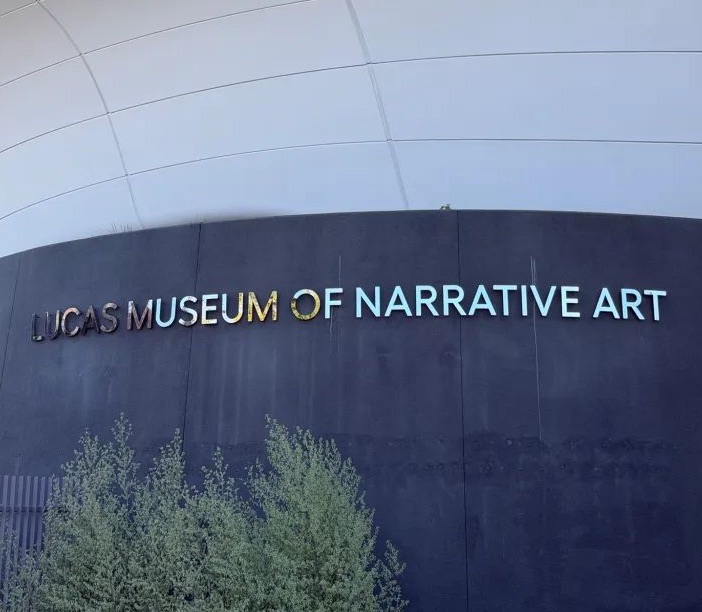

I went to the Lucas Museum of Narrative Art in Exposition Park, Los Angeles, on what was essentially a full opening day. Tickets were around $25, and I booked them a month ahead. The museum was better organized than I expected. The entrance was clear, bag check was easy, and the lines were short.
The building
The first thing I noticed was that it doesn’t feel like a museum. No long straight hallways, no string of rectangular rooms. It’s curves and open space, with walls that rise higher than you expect and windows letting in real daylight. The galleries branch off from that central space, so you drift from one story to the next instead of following a set path.
The elevator was the first thing that got me. It’s rounded and enclosed, and stepping in felt like boarding a capsule that was about to carry me somewhere. I’ve ridden a lot of elevators, and none of them made me feel like a scene was about to start.
Then the view opened up. Through the glass I could see the museum’s main space below me, and past it, parts of the outside. When I first rode up, the floor below was steady but not crowded. By 2 or so, it had filled in, and I could watch it happen from above.
Fine art
Looking at all the fine art is where I spent the most time, and what held me was how many of the paintings center Black lives. There’s Henry Ossawa Tanner’s “The Banjo Lesson,” Ernie Barnes’s “Quintet” and “The Master Table,” and Norman Rockwell’s “The Problem We All Live With,” which shows Ruby Bridges walking to school.


Comics, strips, and manga
The comics section was the part I didn’t expect to love. There are original Garfield strips by Jim Davis from 1983, 1985, and 1989, plus Felix the Cat, Popeye, and other newspaper comics, and original art from Akira.
Then there are the cover drawings, including Neal Adams’s 1971 Superman cover, “The Amazing New Adventures of Superman: Kryptonite Nevermore!”, the original Batman, and others. They’re shown as they were right before printing. Some still have trim lines, margin notes, and correction marks, the evidence that a person was making decisions on that page before it went to press.
I’m used to seeing the finished comic. Here it was the work in progress: a page still being decided on, not yet the version everyone knows.
Star Wars
Star Wars gets its own dedicated section, and it’s a full one. Some of the ships are scale models, and the characters are displayed in replica costumes: R2-D2, C-3PO, a Tusken Raider family, a Jawa, Luke Skywalker, and Mace Windu. I’d rather tell you they’re replicas up front than have you find out at the placard.
The costumes are where I slowed down. Even as replicas, they’re not clean. Someone chose to age them, and up close you can see it in the stitching, the fasteners, the weathering, and the way materials change from one layer to the next. In a film, a costume is on screen for a few seconds. Standing next to one, I could see how many decisions went into it.
Gift shop and cafe
The shop covers more than Star Wars. There are postcard prints and larger prints, a Frida Kahlo section, stationery, bags, keychains, and apparel. What I didn’t expect was the wall of art reference books, and they’re not all about Lucas or comics. They cover other artists too.
At the cafe I got the mac and cheese, a grilled cheese sandwich, and a chocolate and vanilla swirl ice cream cup. At checkout you set your tray down like it’s being weighed, and it scans everything on it and puts the items and prices on a screen. My lunch came to around $16. For a brand-new museum, that’s not what I expected.
Things to know
- If you arrive in the morning, it’s not crowded. It was steady when I arrived at 11, and by about 2 it had filled in. If you want space around the art, go earlier than I did.
- The Star Wars costumes are replicas, and some ships are scale models. Still worth seeing, just go in knowing that. Beyond that, I honestly didn’t have complaints.
Leaving
I spent about four hours here, 11 to 3, and I could have stayed longer. Some of what stayed with me: the pod elevator, the comic covers still marked up for print, and the Star Wars costumes up close. I left with a mini book on Artemisia Gentileschi and a Thomas Hart Benton print, “Instruction (The Bible Lesson),” from around 1950. It’s a good pick for a day out or a date. I’m curious what it’s like on a Friday night, when it’s open until 9.
Leave a Reply